
English
Views: 0 Author: Site Editor Publish Time: 2026-09-02 Origin: Site


Nickel-metal hydride batteries, commonly known as Ni-MH batteries, are rechargeable batteries widely used in consumer electronics, toys, flashlights, medical equipment, emergency lighting, and various industrial devices.
Although lithium-ion batteries are increasingly common, Ni-MH batteries remain a practical choice for many applications because of their reliable performance, rechargeable design, good power capability, and availability in standardized cylindrical sizes.
Among the most common Ni-MH battery sizes are AAA, AA, C, and D. But how do you choose the right one?
The answer depends on more than battery size. Capacity, voltage, discharge current, physical dimensions, charging requirements, operating temperature, and expected service life should all be considered.
This guide explains the main differences between AA, AAA, C, and D Ni-MH batteries and provides practical tips for choosing the right battery for your application.
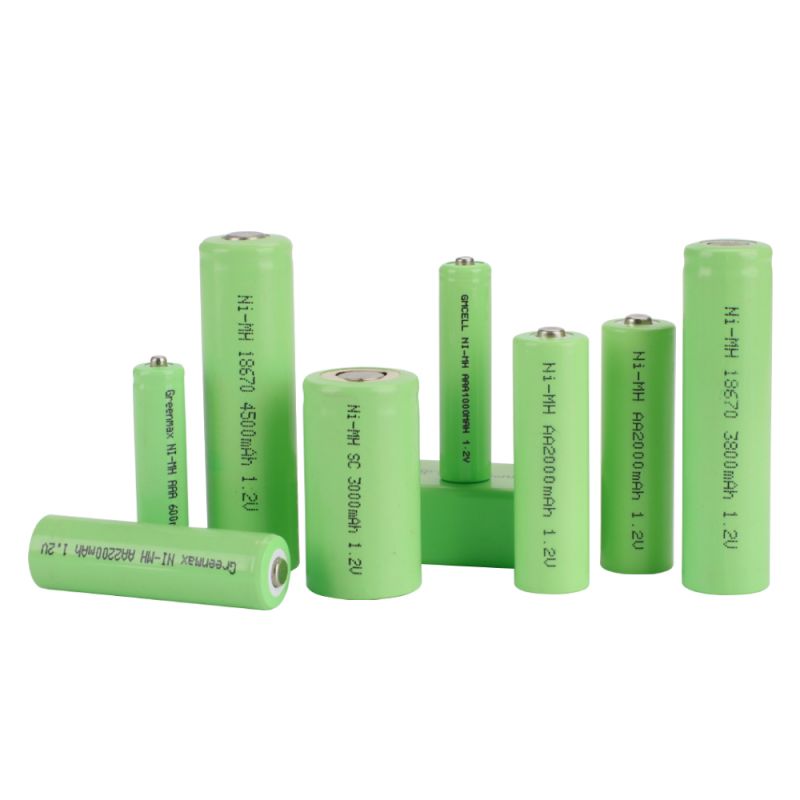
Ni-MH stands for Nickel-Metal Hydride. It is a rechargeable battery technology that uses a nickel-based positive electrode and a hydrogen-absorbing alloy as the negative electrode.
A typical Ni-MH cell has a nominal voltage of 1.2V.
When several cells are connected in series, the voltage increases. For example:
1 cell: approximately 1.2V
2 cells: approximately 2.4V
3 cells: approximately 3.6V
4 cells: approximately 4.8V
6 cells: approximately 7.2V
The actual battery voltage changes during charging and discharging, so the nominal voltage should be used mainly as a reference for system design.
Unlike primary alkaline or zinc-carbon batteries, Ni-MH batteries are designed to be recharged and reused. This makes them particularly attractive for products that require frequent battery replacement or regular charging.

Ni-MH batteries have several characteristics that make them suitable for a wide range of applications.
Ni-MH batteries can be charged and reused many times when operated with a suitable charger and under appropriate conditions.
Many Ni-MH cells can provide relatively high current compared with conventional disposable batteries. This makes them suitable for equipment with moderate or high power requirements.
AAA, AA, C, and D formats are widely recognized cylindrical battery sizes. This makes them convenient for both equipment manufacturers and end users.
Ni-MH batteries can be found in products such as:
Digital cameras
Flashlights
Toys
Remote controls
Wireless devices
Medical equipment
Emergency lighting
Industrial instruments
Portable electronic equipment

The main difference between these battery sizes is their physical dimensions and typical capacity.
In general, a larger battery can accommodate more active material and therefore has the potential to provide greater capacity. However, battery capacity is also affected by cell design and manufacturing technology.
Battery Size | Main Advantage | Typical Applications |
|---|---|---|
AAA | Compact and lightweight | Remote controls, small electronics |
AA | Balanced size and capacity | Cameras, toys, flashlights, electronics |
C | Higher capacity | Lighting, toys, industrial equipment |
D | High capacity and long runtime | Emergency lighting, industrial equipment |
It is important to remember that a larger battery is not automatically better. The correct size is the one that matches the requirements of the equipment.

AAA is one of the smallest common cylindrical Ni-MH battery sizes.
Its compact dimensions make it suitable for products where space and weight are important.
Typical applications include:
Remote controls
Wireless keyboards and mice
Compact electronic devices
Small flashlights
Personal care products
Portable instruments
Small toys
The main advantage of AAA is its compact design. However, its smaller size also limits the amount of energy it can store compared with larger AA, C, and D cells.
Therefore, AAA is generally a good choice when the device has relatively modest energy requirements and a compact battery compartment.

AA Ni-MH batteries are among the most commonly used rechargeable cylindrical batteries.
They provide a good balance between size, capacity, weight, and performance, making them suitable for many different applications.
Common applications include:
Digital cameras
Flashlights
Toys
Game controllers
Wireless devices
Household electronics
Measuring instruments
Portable equipment
AA is often a practical choice when AAA does not provide enough capacity but a larger C or D battery would be unnecessarily large.
For many general-purpose applications, AA offers an excellent compromise between portability and energy capacity.

C-size Ni-MH batteries are larger than AA cells and can gnerally provide higher capacity.
They are suitable for applications where longer runtime is required but the equipment does not need a battery as large as a D cell.
Typical applications include:
High-power flashlights
Emergency lighting
Toys
Industrial equipment
Electronic instruments
Portable lighting systems
The main trade-off is size and weight.
If an application can accommodate a C battery and requires more energy than an AA battery can provide, C may be a suitable option.

D-size Ni-MH batteries are larger and are typically selected when high capacity and extended operating time are important.
Potential applications include:
Emergency lighting
Large flashlights
Industrial equipment
Backup systems
Medical equipment
Portable power equipment
The larger physical volume allows D cells to provide substantially more capacity than smaller cylindrical formats in many designs.
However, D batteries also take up more space and add more weight. Therefore, they are best suited to equipment where long runtime is more important than compactness.

The choice between AA and AAA is usually straightforward.
Choose AAA when:
The product has limited space
Low weight is important
Energy consumption is relatively low
A compact battery is preferred
Choose AA when:
More capacity is required
Longer runtime is needed
The equipment has enough space
A balance between size and performance is desired
In simple terms:
AAA is better for compact applications, while AA provides a better balance between capacity and size.

C and D batteries are both suitable for higher-capacity applications.
Choose C when you need higher capacity than AA but still want to control the overall size and weight.
Choose D when maximum runtime and high capacity are more important than compactness.
For example, a small portable device may be better suited to AA or C batteries, while an emergency lighting system designed to operate for a long period may benefit from D-size cells.

Battery capacity is usually expressed in mAh, or milliampere-hours.
For example, a 2,000mAh battery theoretically has a charge capacity of 2,000 milliampere-hours under specified test conditions.
A simple way to estimate operating time is:
Operating Time ≈ Battery Capacity ÷ Load Current
For example, if a 2,000mAh battery supplies a device drawing 200mA:
2,000mAh ÷ 200mA ≈ 10 hours
However, this is only a simplified estimate. Actual runtime can be affected by discharge current, battery temperature, internal resistance, battery age, device efficiency, and the manufacturer's capacity test conditions.
Therefore, mAh should not be considered the only factor when selecting a battery.

Not necessarily.
A higher-capacity battery can provide longer runtime, but the battery may have different discharge characteristics, physical dimensions, or cycle-life performance.
For some applications, a battery optimized for high capacity is ideal.
For others, high discharge capability or long cycle life may be more important.
For example, equipment that operates continuously may prioritize capacity, while a device with frequent charge-discharge cycles may place greater emphasis on cycle life and reliability.
The best battery is therefore not simply the one with the highest mAh rating. It is the battery that provides the right combination of capacity, current capability, lifetime, and physical compatibility.

Capacity tells you how much charge a battery can store, but it does not tell the entire story about how the battery performs under load.
Some devices require relatively high current, especially those containing motors or other high-power components.
Examples include:
Motorized toys
High-output flashlights
Digital cameras
Industrial equipment
Portable electronic devices
For these applications, check the battery's continuous discharge capability, peak current capability, and internal resistance where applicable.
A battery with sufficient capacity but insufficient current capability may not perform as expected.

Proper charging is essential for battery performance and service life.
Ni-MH batteries should be charged using a charger designed for Ni-MH chemistry and the appropriate number of cells.
Charging conditions can depend on:
Battery capacity
Charging current
Cell temperature
Battery configuration
Charger design
Charging control method
Fast charging can reduce charging time, but it requires appropriate charging control. For professional products, the charging system should always be matched to the specific battery design.
It is also important to avoid using an unsuitable charger simply because the battery has the same physical size.

There is no single cycle-life figure that applies to every Ni-MH battery.
Battery lifetime depends on factors such as:
Depth of discharge
Charging method
Charging current
Discharge current
Operating temperature
Storage conditions
Battery design
Proper charging and appropriate operating conditions can help extend battery life.
For applications that require frequent cycling, it is especially important to evaluate the manufacturer's cycle-life data under conditions that are similar to the actual application.
Self-discharge is the gradual loss of stored energy when a battery is not being used.
Modern Ni-MH technology includes low-self-discharge designs, which are particularly useful when batteries need to remain stored for extended periods.
These batteries can be attractive for:
Emergency equipment
Backup systems
Household devices
Intermittently used equipment
Portable electronics
If a product may remain unused for weeks or months, self-discharge performance should be considered during battery selection.
Before choosing a Ni-MH battery, consider the following questions.
Check whether the equipment uses AAA, AA, C, D, or another battery format.
Determine the required system voltage and the number of cells needed.
Estimate the desired operating time and select a suitable capacity.
Check both continuous and peak current, especially for high-drain applications.
Confirm the maximum battery diameter, length, and weight.
Make sure the charger and charging conditions are compatible with the selected Ni-MH battery.
Consider temperature, storage conditions, vibration, and other environmental factors.
For applications with frequent cycling, cycle life and durability may be more important than maximum capacity.
Choosing the right Ni-MH battery can be summarized as follows:
AAA Ni-MH
Best for compact and lightweight devices where energy requirements are relatively low.
AA Ni-MH
A versatile choice offering a good balance between size, capacity, and performance.
C Ni-MH
Suitable for applications requiring greater capacity and longer runtime while keeping the battery system smaller than a D-cell solution.
D Ni-MH
Best suited to applications where high capacity and extended operating time are priorities.
Choosing a Ni-MH battery should not be based on battery size or capacity alone.
AAA, AA, C, and D batteries each have different characteristics and are designed to meet different application requirements. Smaller AAA cells are ideal for compact devices, while AA batteries provide a versatile balance of size and capacity. C and D batteries are more suitable when higher capacity and longer operating time are required.
Before selecting a battery, always consider nominal voltage, capacity, discharge current, physical dimensions, charging method, cycle life, self-discharge, and operating temperature.
For standard applications, an appropriately selected cylindrical Ni-MH battery may provide a simple and reliable rechargeable power solution. For industrial and OEM applications, however, a customized Ni-MH battery pack may be more suitable when specific voltage, capacity, dimensions, connectors, or performance requirements need to be met.
Ultimately, the best Ni-MH battery is not necessarily the largest or highest-capacity option. It is the battery that provides the right combination of performance, reliability, service life, and cost for the intended application.


